Main Pages: [
NWRA SpaWx Services Home |
SpaWx Indices Home |
Scintillation Home |
Scintillation Services Home |
]
Graphics: [
F10 |
Ap |
F10/Ap Forecasts |
SSNe |
SSN Comparison |
24hr SSNe |
Auroral Boundary (TIROS) |
Auroral Qe Index (DMSP)
]
Listings/Reports: [
Indices Table |
Events |
RSGA |
SGAS |
SRS
]
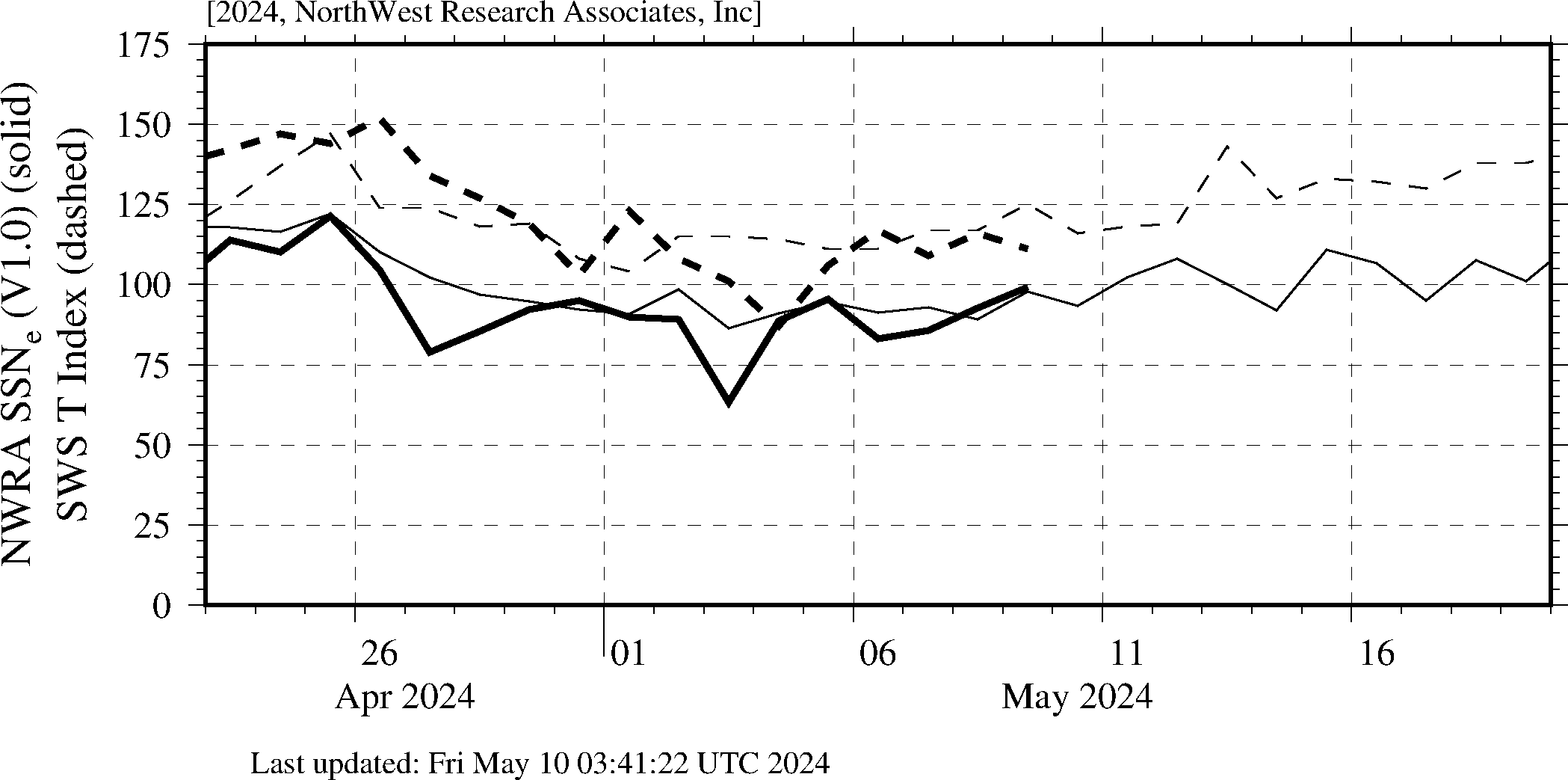
Note: Heavy (dark) lines are for the current 27-day Bartel rotation;
light lines are for the last rotation.
If you are looking for the observed sunspot number derived from optical
observations of the sun, you've been miss-routed.
This link provides a comparison of
the effective SSN shown on this page to the observed solar sunspot
number.
The effective sunspot number (SSNe) index is defined as that SSN which
will return a zero average-error between foF2 values generated from a
model (to which the SSNe is input) and a set of foF2 observations.
The NWRA SSNe (solid lines on the plot) is generated by Northwest
Research Associates, Inc., using mid-latitude foF2 observations from a
single day as input (provided by the NOAA SWPC) and is based on the
URSI-88 model.
The IPS
T-index (dashed lines) is similar to the SSNe index in concept, although it is
calculated using a different algorithm. The index plotted here is the
daily value valid for the Australian sector calculated by the
Australian IPS Radio and Space Services organization in Sydney, AU, as
reported in their Daily Solar and Geophysical Report.
References for the SSNe and T indexes are as follows:
- Secan, J.A. and P.J. Wilkinson, Statistical studies of an effective
sunspot number, Radio Science, 32, 1717-1724, 1997.
[A comparison of various effective sunspot-number indices and
discussion of the NWRA SSNe calculation.]
- Thompson, R. L., User requirements of aerospace propagation-environment
modeling and forecasting, in Operational Modeling of the Aerospace
Propagation Environment, AGARD-CP-238, edited by C. Soicher, 1978.
[A brief discussion of an SSNe calculated by the USAF, no longer
available outside the USAF.]
- Turner, J.F., The development of the ionospheric index T, IPS
Series R Report, R11, June, 1968.
- Caruana, J., The IPS monthly T index, Solar-Terrestrial
Predictions, Proceedings of a workshop at Leura, Australia October
16-20, 1989, Vol 2, pp 257-263, 1990.
- Wilkinson, P.J., Predictability of ionospheric variations for quiet
and disturbed conditions, J. Atmosph. Terr. Phys., 57, 1469-1481,
1995.

NWRA Space Weather Links
[
Space Weather Home Page |
Scintillation Home Page
]


[
Home |
Site Map |
Company |
Staff |
Research Areas |
Services |
Products
]
How to contact NWRA
Copyright © 1996-2011 NorthWest Research Associates, Inc. All rights reserved.